
Description
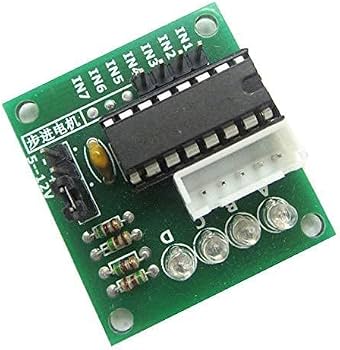
ULN2003 Stepper Motor Driver Board For Arduino Avr SMD in pakistan
The ULN2003 Stepper Motor Driver Board is an easy-to-use motor interface module for controlling small stepper motors. It commonly comes with a five-wire connector compatible with the 28BYJ-48 unipolar stepper motor, making motor connections simple and convenient.
The board uses a ULN2003 Darlington transistor array containing seven NPN Darlington pairs. These transistor channels act as switches, allowing low-current control signals from a microcontroller to operate the motor windings.
It is compatible with Arduino and AVR-based development projects and is suitable for applications that require controlled rotation, positioning and step-by-step movement.
Technical Specifications
| Specification | Details |
|---|---|
| Product Name | ULN2003 Stepper Motor Driver Board |
| Driver IC | ULN2003 |
| IC Technology | Darlington Transistor Array |
| Driver Channels | 7 |
| Motor Compatibility | Compatible unipolar stepper motors |
| Common Motor | 28BYJ-48 |
| Controller Compatibility | Arduino, AVR and compatible microcontrollers |
| Control Method | Digital switching signals |
| Motor Connector | Typically 5-wire connector |
| Applications | Robotics and automation |
Note: The exact PCB layout, connector type, indicator LEDs and supported motor voltage depend on the board version. The motor supply must match the connected stepper motor.
Key Features
-
ULN2003 Driver IC: Uses a seven-channel Darlington transistor array for switching motor windings.
-
28BYJ-48 Compatibility: Commonly designed for the popular 5-wire unipolar stepper motor.
-
Arduino Integration: Supports stepper motor control using compatible Arduino libraries.
-
AVR Compatibility: Can be used with AVR-based microcontroller projects.
-
Simple Connections: Provides convenient motor and power connections.
-
Step-by-Step Movement: Allows controlled rotation and positioning.
-
Compact Design: Suitable for small robotics and automation projects.
Applications
-
28BYJ-48 motor control
-
DIY robot mechanisms
-
Automatic rotating platforms
-
Small positioning systems
-
Electronic automation projects
-
Educational robotics
-
AVR microcontroller applications
Installation and Setup
-
Connect a compatible stepper motor, such as the 28BYJ-48, to the board’s motor connector.
-
Connect the motor power supply to the appropriate input terminals.
-
Connect the four control inputs to suitable Arduino or AVR digital output pins.
-
Connect the controller ground and driver-board ground together.
-
Upload a compatible stepper motor program.
-
Set the stepping sequence and motor speed in your program.
-
Test the motor at a low speed before using it in a mechanical assembly.
Example Arduino pin connections:
| ULN2003 Input | Arduino UNO |
|---|---|
| IN1 | D8 |
| IN2 | D9 |
| IN3 | D10 |
| IN4 | D11 |
| GND | GND |
| VCC | Suitable motor supply |
The example pin assignments are interchangeable when the Arduino code is configured accordingly. Use the correct motor supply voltage for your specific 28BYJ-48 version.
Precautions
-
Do not connect a stepper motor directly to Arduino GPIO pins.
-
Use a suitable external motor power supply when necessary.
-
Check motor voltage requirements before applying power.
-
Ensure correct wiring between the driver board and motor.
-
Avoid excessive motor loading.
-
Do not exceed the ULN2003 channel and total package current limits.
-
Provide adequate ventilation during extended operation.
-
Remember that the ULN2003 is a transistor driver, not a regulated stepper motor current-control driver.
YouTube Tutorial
Watch ULN2003 Stepper Motor Driver Arduino Tutorials
Buy from Electroway Pakistan
Build your next Arduino automation or robotics project with the ULN2003 Stepper Motor Driver Board. Explore stepper motors, Arduino boards, motor drivers and electronic components at Electroway.org. Discover more electronics products through the Electroway App.
4. Product Summary
The ULN2003 Stepper Motor Driver Board is a compact motor-control module designed for compatible unipolar stepper motors, especially the 28BYJ-48. With its seven-channel Darlington transistor array, it provides a convenient interface for Arduino, AVR and other microcontroller-based robotics and automation projects.
Reviews
There are no reviews yet.