
Description
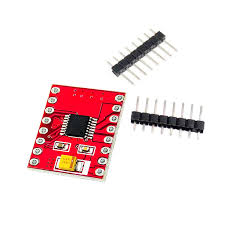
TB6612 / DRV8833 Dual Motor Driver Module
The TB6612 / DRV8833 Dual Motor Driver Module is a compact motor-control solution designed for small DC motors used in robotics, automation, and electronics projects. It uses H-Bridge circuitry to control motor direction and speed through signals from a microcontroller such as Arduino, ESP32, or Raspberry Pi Pico.
The module provides two independent motor channels, allowing users to control two DC motors separately. By applying PWM signals, users can adjust motor speed, while digital control inputs determine the direction of rotation.
Depending on the installed driver IC, the module may use either the Toshiba TB6612FNG or Texas Instruments DRV8833. These are different driver chips with different electrical specifications, so the exact IC marking should be checked before selecting a power supply or motor.
Asia-English+1
Technical Specifications
| Specification | Details |
|---|---|
| Product Type | Dual DC Motor Driver Module |
| Driver IC | TB6612FNG or DRV8833, depending on version |
| Driver Architecture | Dual H-Bridge |
| Motor Channels | 2 independent channels |
| Motor Compatibility | Brushed DC motors |
| Stepper Compatibility | One bipolar stepper motor |
| Control Method | PWM and digital direction inputs |
| Motor Functions | Forward, reverse, brake and stop |
| Logic Compatibility | Commonly 3.3V and 5V control systems; check module version |
| Typical Current Class | Approximately 1A per channel on common module versions |
| Main Applications | Arduino, robotics and automation |
Important electrical differences:
| Specification | TB6612FNG | DRV8833 |
|---|---|---|
| Motor Supply Range | Commonly 2.5–13.5V | 2.7–10.8V |
| Continuous Current | 1.2A average per channel (IC rating) | Package-dependent; up to 1.5A RMS per bridge on certain versions |
| Peak Current | 3.2A specified peak | Up to 2A peak per bridge under specified conditions |
| Motor Channels | 2 | 2 |
These are chip-level specifications, not guaranteed continuous ratings for every breakout module. PCB design, cooling, and package type affect actual performance.
Toshiba Semicon Storage+1
Key Features
-
Dual H-Bridge Design: Controls two independent brushed DC motors.
-
Bidirectional Motor Control: Supports forward and reverse rotation.
-
PWM Speed Regulation: Adjusts motor speed using PWM signals from a microcontroller.
-
Compact Design: Suitable for small robots and space-limited electronics projects.
-
Microcontroller Compatibility: Can interface with compatible Arduino, ESP32, and Raspberry Pi Pico boards.
-
Motor Braking: Supports braking functions depending on the driver IC and control signals.
-
Stepper Motor Support: Can operate one compatible bipolar stepper motor.
-
Efficient Motor Driving: MOSFET-based output stages help reduce power losses compared with older bipolar motor-driver designs.
Applications
-
Arduino obstacle-avoiding robots.
-
Bluetooth-controlled robotic cars.
-
Line-following robots.
-
Two-wheel differential-drive robots.
-
Small DC motor speed-control projects.
-
Educational robotics and STEM projects.
-
Miniature conveyor systems.
-
Small automation mechanisms.
-
Bipolar stepper motor experiments.
How to Connect and Use
-
Connect motor power: Connect the appropriate DC motor supply to the module’s motor-power input.
-
Connect ground: Connect the motor supply ground and microcontroller GND together.
-
Connect the motors: Attach the first motor to output A and the second motor to output B.
-
Connect control pins: Connect the direction and PWM input pins to compatible Arduino or other microcontroller GPIO pins.
-
Enable the driver: Connect the standby or sleep control pin as required by the particular module.
-
Upload your program: Use digital signals to select motor direction and PWM signals to regulate speed.
-
Test operation: Start with a low PWM value and gradually increase it while monitoring motor and driver temperature.
Precautions
-
Verify whether your module contains TB6612FNG or DRV8833 before applying motor power.
-
Never exceed the motor supply voltage specified for the installed driver IC.
-
Do not treat peak current as a continuous operating rating.
-
Check the motor’s startup and stall current before connecting it.
-
Connect the microcontroller and motor supply grounds together.
-
Do not connect motors directly to Arduino GPIO pins.
-
Use suitable wiring and cooling for the expected motor current.
-
Avoid short-circuiting motor output terminals.
-
Disconnect power before changing motor or module connections.
YouTube Tutorial
Explore wiring, programming, and practical motor-control demonstrations:
TB6612 and DRV8833 Arduino Dual Motor Driver Tutorials
Buy Dual Motor Driver Module in Pakistan
Looking for a compact motor driver for your next robotics or Arduino project?
Explore motor drivers, Arduino boards, sensors, electronic components, and robotics accessories through Electroway.org and the Electroway App. Check product availability and discover components for your DIY electronics projects.
5. Product Summary
The TB6612 / DRV8833 Dual Motor Driver Module is a compact H-Bridge controller for operating two brushed DC motors independently. It supports bidirectional movement, PWM speed regulation, and motor braking, making it useful for Arduino robots, Bluetooth-controlled cars, line-following robots, and automation projects. Always verify the installed driver IC and its current and voltage ratings before connecting motors.


Reviews
There are no reviews yet.