


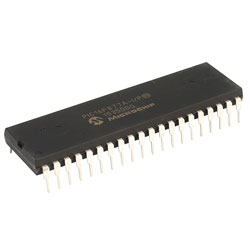
Microchip PIC16F877A 20MHz 8-Bit PIC Microcontroller
The Microchip PIC16F877A 20MHz 8-Bit PIC Microcontroller is a versatile integrated circuit used to develop programmable electronic control systems. It combines a processor, program memory, data memory, digital I/O ports, timers, communication interfaces, and analog input capabilities in a single chip.
With its 40-pin PDIP package, the PIC16F877A is convenient for breadboard-compatible prototyping, development boards, and through-hole circuit assembly. It is commonly used in projects involving sensor monitoring, LCD interfacing, motor control, automation, and embedded programming.
The microcontroller supports several communication protocols, including UART/USART, SPI, and I²C. Its built-in analog-to-digital converter allows it to read signals from compatible analog sensors, while its timer and PWM-related peripherals support timing and control applications.
For the official datasheet, pinout, and technical documentation, visit the Microchip PIC16F877A product page.
Technical Specifications
| Specification | Details |
|---|---|
| Manufacturer | Microchip Technology |
| Model | PIC16F877A |
| Microcontroller Type | 8-bit PIC microcontroller |
| Maximum Clock Frequency | 20 MHz |
| Program Memory | 8K × 14-bit words Flash |
| Data RAM | 368 bytes |
| Data EEPROM | 256 bytes |
| Package | 40-pin PDIP |
| Operating Voltage | Depends on operating conditions; check datasheet limits |
| Digital I/O | 33 programmable I/O pins |
| ADC | 10-bit, 8 channels |
| Timers | 3 timer modules |
| CCP Modules | 2 Capture/Compare/PWM modules |
| Communication Interfaces | USART, SPI, I²C |
| Analog Comparators | 2 |
| Programming | Compatible PIC programmer and development tools |
| Applications | Embedded systems, automation, robotics, and sensor interfacing |
Memory clarification: The PIC16F877A has 8K × 14-bit words of Flash program memory, 368 bytes of RAM, and 256 bytes of EEPROM. The Flash memory’s 14-bit word organization is different from the byte-based organization of RAM and EEPROM. Microchip
Key Features
1. 8-Bit Microcontroller Architecture
The PIC16F877A is designed for embedded control applications that require programmable logic, sensor inputs, and digital outputs.
2. 20MHz Clock Operation
Supports clock operation up to 20 MHz, making it suitable for many real-time control and electronics projects.
3. Flash Program Memory
The 8K × 14-bit program memory provides space for firmware used to control electronic devices and embedded systems.
4. Analog-to-Digital Conversion
The built-in 10-bit ADC has eight input channels for reading compatible analog sensors and voltage signals.
5. Multiple Communication Interfaces
UART/USART, SPI, and I²C support communication with compatible computers, displays, sensors, and peripheral modules.
6. PWM and Timer Functions
The two CCP modules and three timers support applications involving pulse generation, timing, measurement, and motor-control signals.
7. Non-Volatile EEPROM
The 256-byte EEPROM can store configuration values and other small data items that need to be retained when power is removed.
8. 40-Pin PDIP Package
The through-hole package is convenient for prototyping, socket installation, and custom circuit-board assembly.
Applications
The PIC16F877A microcontroller is suitable for a variety of electronics and embedded systems projects.
- Sensor Interfacing: Read data from compatible temperature, light, and other analog sensors.
- LCD Projects: Control compatible character LCDs and other display interfaces.
- Robotics: Develop control logic for robots and small automated systems.
- Motor Control: Generate control signals for compatible motor-driver circuits.
- Home Automation: Build programmable lighting and appliance-control systems.
- Industrial Control: Create small embedded monitoring and control circuits.
- Data Acquisition: Read and process analog signals through the onboard ADC.
- Educational Projects: Learn PIC programming, timers, interrupts, communication protocols, and embedded C.
Programming and Usage
To begin using the PIC16F877A:
- Choose a compatible programmer: Use a PIC programming tool that supports the PIC16F877A.
- Install development software: Set up a compatible version of MPLAB X IDE and the required compiler.
- Create a project: Select the PIC16F877A as the target microcontroller.
- Write the firmware: Configure the required I/O pins, timers, ADC channels, and communication interfaces.
- Configure the oscillator: Select the appropriate oscillator configuration for your circuit.
- Program the IC: Upload the compiled firmware using the compatible programmer.
- Test the circuit: Verify the supply voltage, reset circuit, oscillator, and pin connections before connecting external devices.
For software, programming information, and datasheets, visit the official Microchip PIC16F877A documentation page.
Precautions
- Verify the IC pinout before connecting it to a circuit.
- Keep the supply voltage within the datasheet’s permitted limits.
- Confirm the voltage requirements of connected sensors and peripherals.
- Do not connect motors, relays, or other high-current loads directly to microcontroller pins; use suitable driver circuits.
- Configure the oscillator and programming settings correctly.
- Avoid short circuits and electrostatic discharge.
- Use a compatible programmer and verify the device model before programming.
- Check the official datasheet for electrical limits and pin-specific restrictions.
YouTube Tutorial
Explore PIC16F877A programming, circuit design, and practical project tutorials:
Watch PIC16F877A Microcontroller Programming Tutorials on YouTube
Buy PIC16F877A Microcontroller in Pakistan
Looking for a programmable microcontroller for your next electronics project? Visit Electroway to check current product availability and pricing.
You can also explore our ICs and Logic Components category for more integrated circuits and microcontroller components.
4. Product Summary
The Microchip PIC16F877A is an 8-bit microcontroller with a maximum clock frequency of 20 MHz, 8K × 14-bit words of Flash program memory, 368 bytes of RAM, and 256 bytes of EEPROM. Its 40-pin PDIP package, 10-bit ADC, communication interfaces, timers, and PWM-related peripherals make it suitable for embedded systems, sensor interfacing, automation, and educational electronics projects.

Reviews
There are no reviews yet.