


How PIR Motion Sensor Works
If you’ve ever used an automatic light or a motion-based security system, you’ve already experienced a PIR motion sensor in action. But how exactly does it work?
In this guide, you’ll learn how PIR motion sensor works, its internal components, real-life applications, and how students in Pakistan can use it in Arduino and IoT projects.
What is a PIR Motion Sensor?
A PIR (Passive Infrared) sensor is an electronic device that detects motion by sensing changes in infrared radiation (heat) emitted by objects like humans and animals.
Unlike active sensors, PIR sensors do not emit energy — they only detect it.
Key Features
- Detects human movement
- Low power consumption
- Easy to interface with Arduino/ESP32
- Widely used in security systems
👉 Explore available options in Sensors category
How PIR Motion Sensor Works
The working principle of a PIR sensor is based on detecting changes in infrared radiation.
Step-by-Step Working
1. Infrared Radiation Detection
All living beings emit infrared radiation. The PIR sensor detects this heat energy.
2. Dual Sensor Elements
Inside the PIR sensor, there are two IR-sensitive slots:
- One detects baseline temperature
- The other detects changes
When no motion is present, both sensors receive equal radiation.
3. Motion Detection
When a human passes in front of the sensor:
- One slot detects a change in heat first
- Then the second slot detects it
- This creates a difference signal
👉 This change triggers the sensor output.
4. Signal Processing
The sensor processes the difference and sends a HIGH signal (1) to the microcontroller.
- No motion → LOW signal
- Motion detected → HIGH signal
PIR Sensor Internal Components
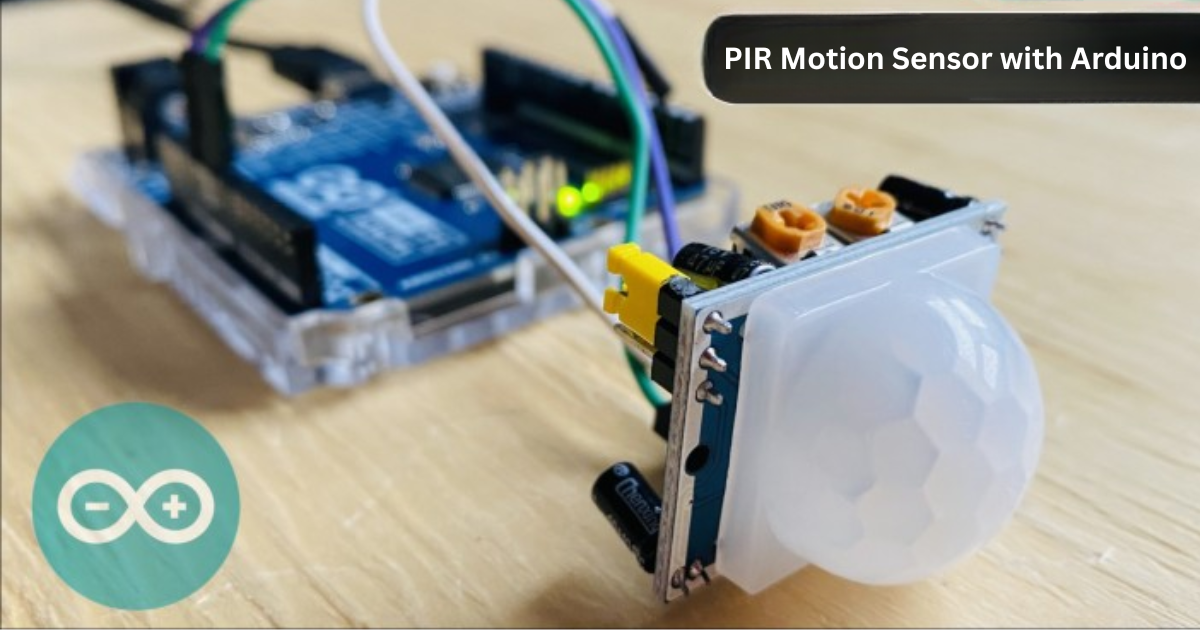
A typical PIR sensor module consists of:
1. Pyroelectric Sensor
This is the core element that detects infrared radiation.
2. Fresnel Lens
The white dome-shaped cover focuses infrared signals onto the sensor.
Why It’s Important
- Increases detection range
- Improves sensitivity
- Expands detection angle
3. Signal Amplifier
Amplifies small signals generated by IR detection.
4. Output Circuit
Sends digital signal (HIGH/LOW) to Arduino or ESP32.
PIR Sensor Pinout
Most PIR sensors (like HC-SR501) have 3 pins:
| Pin | Function |
|---|---|
| VCC | Power (5V) |
| OUT | Output signal |
| GND | Ground |
PIR Sensor Range and Features
Typical Specifications
- Detection Range: 5 to 7 meters
- Detection Angle: ~120°
- Delay Time: Adjustable
- Sensitivity: Adjustable
Applications in Pakistan
PIR sensors are widely used across Pakistan in both student projects and commercial systems.
🔐 Security Systems
- Home alarms
- Office surveillance
- Motion detection alerts
💡 Automatic Lighting
- Street lights
- Corridor lights
- Energy-saving systems
🤖 Arduino & IoT Projects
- Smart home automation
- Smart door systems
- Intruder detection systems
- Final year engineering projects
🏭 Industrial Use
- Machine safety systems
- Automation triggers
Example Arduino Code
Here’s a simple example to read PIR sensor output.
int pirPin = 2;
int ledPin = 13;
void setup() {
pinMode(pirPin, INPUT);
pinMode(ledPin, OUTPUT);
Serial.begin(9600);
}
void loop() {
int motion = digitalRead(pirPin);
if (motion == HIGH) {
digitalWrite(ledPin, HIGH);
Serial.println(“Motion Detected!”);
} else {
digitalWrite(ledPin, LOW);
Serial.println(“No Motion”);
}
delay(1000);
}
Advantages of PIR Sensor
- Low cost
- Easy to use
- Energy efficient
- Reliable for motion detection
- Widely available in Pakistan
Limitations
- Cannot detect stationary objects
- Sensitive to temperature changes
- Limited range
- False triggers in extreme environments
FAQ Section
What does PIR stand for?
PIR stands for Passive Infrared.
Can PIR detect humans only?
It mainly detects heat from living beings like humans and animals.
What is the range of a PIR sensor?
Typically 5–7 meters, depending on the model.
Can PIR work with ESP32?
Yes. PIR sensors work perfectly with ESP32, Arduino, and other microcontrollers.
Is PIR sensor good for final year projects?
Yes. It is widely used in security and automation FYPs in Pakistan.
Final Words
Understanding how PIR motion sensor works is essential for building smart automation and security systems. It is one of the easiest and most practical sensors for students to use in IoT and Arduino projects.
Whether you’re working on a beginner project or a final year system, PIR sensors offer a simple yet powerful way to detect motion.
🚀 Order Sensors Online Today
Get genuine PIR motion sensors and other modules delivered anywhere in Pakistan and start building your smart projects today.