


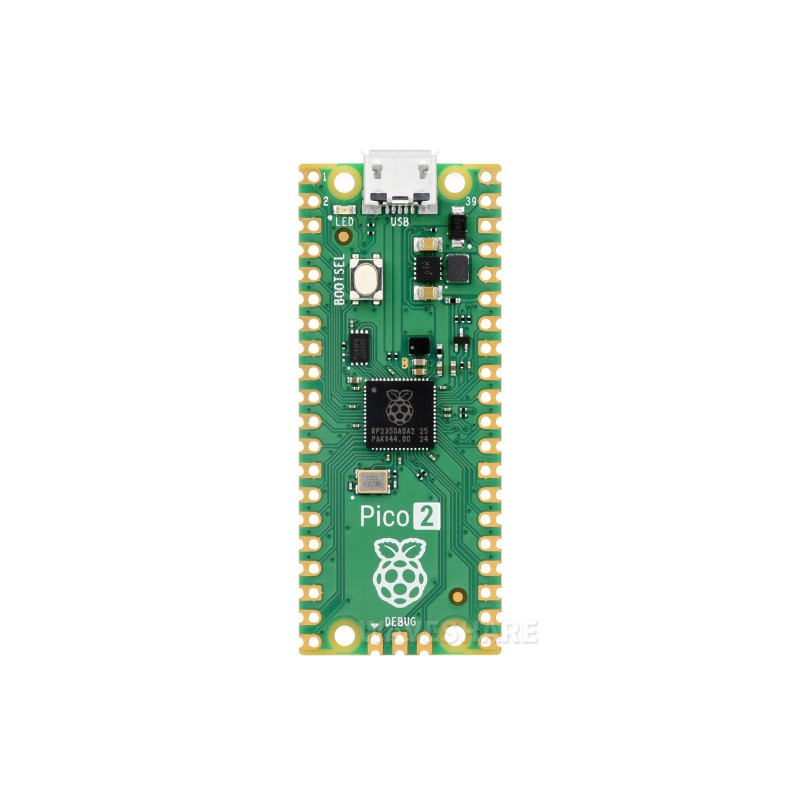
Raspberry Pi Pico Microcontroller
The Raspberry Pi Pico Microcontroller is a compact and affordable development board built around the Raspberry Pi RP2040 microcontroller. It provides a practical set of digital and analog interfaces in a small form factor, making it suitable for both beginner projects and more advanced embedded applications.
At its core, the RP2040 features a dual-core Arm Cortex-M0+ processor with a clock speed of up to 133 MHz and 264 KB of SRAM. The board provides 26 multifunction GPIO pins, along with three 12-bit ADC inputs and PWM capability for controlling LEDs, motors, servos, sensors, displays, and other electronic devices.
The Pico can be programmed using MicroPython, C, or C++. Its USB interface makes programming and serial communication straightforward, while SPI, I2C, and UART interfaces provide convenient connections to external modules and peripherals.
Its small size, low power requirements, and flexible I/O make the Raspberry Pi Pico a useful platform for robotics, automation, IoT prototypes, sensor systems, data logging, educational projects, and custom embedded electronics.
🔗 Browse more ICs & Logic Components at Electroway.
Technical Specifications
| Specification | Details |
|---|---|
| Product Type | Microcontroller Development Board |
| Microcontroller | Raspberry Pi RP2040 |
| CPU | Dual-Core Arm Cortex-M0+ |
| Maximum Clock Speed | Up to 133 MHz |
| SRAM | 264 KB |
| Onboard Flash | 2 MB |
| GPIO | 26 Multifunction GPIO Pins |
| ADC | 3 × 12-bit ADC Inputs |
| PWM | 16 PWM Channels |
| Communication | SPI, I2C, UART |
| USB Interface | Micro-USB |
| Logic Voltage | 3.3V |
| Programming Languages | MicroPython, C, C++ |
| Power Options | USB / VSYS |
| Board Dimensions | Approx. 51 × 21 mm |
Applications
- DIY electronics and embedded projects
- Robotics and automation systems
- Sensor-based projects
- IoT and smart-device prototypes
- Motor, servo, and LED control
- Display and user-interface projects
- Data logging applications
- Home automation
- Educational programming and electronics
- Custom control systems
Precautions
- GPIO pins use 3.3V logic and should not be connected directly to incompatible higher-voltage signals.
- Do not exceed the recommended voltage or current limits of the board.
- Use suitable driver circuits for motors, relays, and other high-current loads.
- Disconnect power before changing circuit connections.
- Avoid short circuits and protect the board from static discharge.
- Keep the Pico away from moisture and excessive heat.
Related Products
- ICs & Logic Components
- Arduino & Microcontroller Boards
- Sensors & Modules
Reviews
There are no reviews yet.